
The following article by Charles Hartley was first published in December 2025 in The Pioneer News.
Today we are visiting two Shepherdsville lots, an original part of which has not seen the light of day since before the Civil War. Join me at the intersection of Walnut Street and Joe B. Hall Avenue (Second Street for old timers), just west of the underpass beneath the railroad tracks. I've marked the spot X on the accompanying drawing.
While Walnut Street ends at Joe B. Hall Avenue today, originally it extended southward toward the river, and the two lots we seek lay to the east of that extended street.
When Ben Stansbury drew the first Shepherdsville plat he numbered these two lots as 41 and 42; but James Shanks' later plat numbered them as 45 and 46, as shown on this drawing.
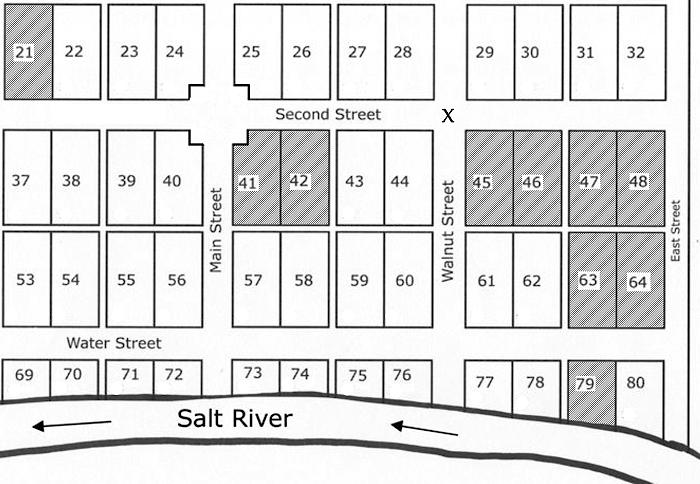
Among the men who first purchased Shepherdsville lots was Ben Summers who bought 10 lots (shaded on the drawing) in June 1797, including these two. In fact he purchased six of the eight lots bounded by Walnut Street on the west, East Street on the east, Second Street on the north and Water Street on the south. It appears that he missed getting the other two because John Hugh and John Moore got there first.
Summers was likely buying these lots in anticipation of either renting them out or selling them at a profit. And it appears that he did just that with these two lots. We speculate that he arranged for James Alexander to purchase the lots and pay for them in installments. However, in October 1799 Alexander found it necessary to mortgage the property back to Summers to cover debts he owed.
That mortgage document described the property as "two lots of ground in the town of Shepherdsville, whereon his tanyard is with all the leather and hides."
Thus it appears that James Alexander began the tanning operation at this site that was to last for more than half a century.
Alexander was an ambitious man. We know that he obtained a license to operate a tavern in Shepherdsville in August 1799 with Ben Summers his security on the bond. This was possibly located on one of these two lots.
In 1802, he married Abigail Floyd Smith, widow of Thomas Smith, and mother of three children including Mary Floyd Smith who would marry John William Beckwith in 1807. James and Abigail would have two sons of their own, Sidney and Frederic Grayson Alexander.
James would become a Justice of the Peace for Bullitt County in 1808, and remain as such until it became his time to be sheriff in 1824, a role he would serve until his death in November 1825.
Little more is said about his connection to the tanyard, but the 1810 census suggests he might still be working it as he is recorded with 32 members of his household including 12 males between 16 and 25 years old, as well as 14 enslaved persons; most of whom might have been working as tanners.
In an article about another tanner named Theophile Conrad, David Strange wrote "Tanning animal hide makes a leather that is more durable and less susceptible from decomposition. It can be a malodorous process, because of all the animal remains and because the skins are sometimes 'putrefied' for up to several months as part of the process. Oak 'tan bark,' which provide the tannin chemical needed for curing, is used to treat the leather, giving the material its oaken color."
David continued, "Bullitt County was a natural place for tanneries in the early days of Kentuckiana because of its forests of oak, and especially because of its natural resources of salt. Tanning involves the liberal application of salt to a freshly cleaned skin. Three to five pounds of salt might be used in the treatment of one deer or sheep skin. Bullitt County's salt-water springs provided the only source of salt in the region. Lots of fresh water was also needed, so most tanneries would be established near a good creek."
By 1821, Alexander had relinquished the lots back to Summers for in May of that year Summers sold the lots to George Saunders. No specific mention of the tanyard was mentioned in this deed, however when George sold the lots to Thomas Saunders the following February that deed recorded, "On lot No. 45 is erected a tan yard and said tan yard is now stocked with hides and leather, all of which hides and leather together with the tools and utensils belonging to the tan yard is also hereby conveyed and delivered over to the said Thomas Saunders Sr."
Neither Saunders appeared very interested in operating a tanyard, for less than two years after Summers sold it to George, it passed into the hands of Weir Tilford and Abraham Field in January 1823.
Both Tilford and Field were Shepherdsville merchants. It appears that Tilford went into business with Joseph Bowman, operating under the name of Weir Tilford & Co. Then In October 1827 Tilford and Bowman mortgaged their moiety of the lots to Jacob Bowman, Joseph's father, including "all the right, title and interest of the said Weir Tilford and Joseph Bowman of, in and to the lots and tanyard thereon in the town of Shepherdsville now in the occupancy of Field and Tilford, together with the stock on hand now in the yard and all things belonging or appertaining to the said tanyard."
In February 1829, Jacob Bowman sued Tilford & Co. to foreclose that mortgage, and the Bullitt Circuit Court ordered that George F. Pope be assigned as commissioner to sell the property. Following the sale, Pope returned his report which described in detail what had been sold.
After describing other property sold, Pope wrote, "I also on the same day at the tan yard of Messrs Field and Tilford did sell the two lots Nos. 45 & 46 in said town with the buildings and improvements and the tan yard with all things belonging and attached thereto consisting of one wagon and gear complete, two wagon horses, one bark mill mare and colt and horse, 350 bushels of corn, shop tools, stove, bed etc., 16 hogs, one negro boy named Sam, 35 cords of bark, 109 sides of upper leather in handling, 40 sides of skirting in handling, 41 hog skins, 7 large hides in lime, 16 upper hides in lime, 2 hog skins in lime, 91 sides upper in bate, 41 do sole in bate, 444 lbs finished skirting, 5 sides finished upper leather, 15 finished calf skins, 4 sides of horse leather, hog and deer skins, 35 kip and calf skins in stuff, 34 hides upper in stuff, 6 skins, vats Nos. 1, 2, 10, 17 containing upper and skins, kip, calf and deer; Nos. 9, 16, 19, 23, 24 & 25 containing tanned sole leather and skirting; 11 hides and other loose leather in the cellar with the books etc. of said firm as per estimates; Nos. 1, 2, 3, 4 & 5 herewith returned and made part hereof and the complainant purchased the interest of Weir Tilford and Joseph Bowman mortgaged by said Tilford at and for the sum of $3850."
Now I know that most of you found parts of that confusing so I will define some of the terms. Upper leather was generally like that used to make the upper parts of shoes. I think describing something "in handling" was another way of saying it was in the process of being finished. Skirting was a side of leather before it was cut into parts for use. Leather "in bate" was in the process of rendering the raw hide or skin softer and supple prior to tanning it. Kip skin was the skin of young cattle between 6 months and 2 years old. It was a grade below the finer calfskin. And hides "in lime" referred to the process of soaking the hide in a lime bath for a time to loosen and remove hair and other unwanted things from the hide.
As you can see, this was a large operation with many different parts and was labor-intensive which in those days likely meant by slave labor. And as Jacob Bowman had more slaves than almost any other person in Bullitt County at that time, he almost certainly employed some of them at this tanyard.
Jacob Bowman and Abraham Field would continue to jointly own the two lots and tanning operation for another decade until 1841 when they divided their joint town lots ownership with Field keeping lot 31 while Bowman took the tanyard lots.
Jacob Bowman had married Weir Tilford's sister Eleanor "Nellie" Tilford in 1797, which probably accounts for the extended time he had given Tilford to repay his debts before foreclosing on the mortgage. Jacob and Nellie were the parents of four sons and a daughter; George, Thomas, Jacob, Mary and Joseph, before Nellie's death in 1822. Remaining the patriarch of his family, he remained unmarried until, at 69, he married Permelia Buford Tilford, widow of Weir Tilford who had died in 1834. Permelia would deliver him another daughter, but she died as an infant.
At his death in 1843, Jacob Bowman left a vast estate with thousands of acres of land. He left it up to his heirs to divide his Bullitt County holdings, and in 1844 they jointly sold the tanyard lots to James Doyle, husband of Weir Tilford's daughter Mary.
Doyle, an Irish immigrant, did not have personal wealth sufficient to operate this business alone, and turned to a local investor named Henry J. Craycroft who agreed to provide his support. However, when Craycroft realized that Doyle's mismanagement and his drinking problems were preventing the business from prospering, he took a greater hand in the business. It may be that Craycroft's efforts enabled Doyle to get back on his feet after awhile; however Doyle was soon back in debt again, this time to Joseph Bowman, Jacob's son. Finally, in the Fall of 1851, Bowman was forced to foreclose on Doyle's mortgage to him, and the court ordered the sale of the two lots at auction to pay Bowman who himself became the purchaser of the business. But its days were numbered for it was around this time that the Kentucky General Assembly granted a charter for a company to build a railroad from Louisville toward Nashville, and after considerable debate it was determined that the line should run through Shepherdsville on its way to Elizabethtown.
The engineers determined that the tracks would pass through the gap in the knobs north of town and then follow a straight line southward to where it would cross Salt River. This route would require the tracks to pass through the middle of lot 45.
Railroad lawyers set about making arrangements with property owners for the purchase of right of ways through their land. In many cases these were unrecorded agreements, and it appears that Joseph Bowman may have had such an arrangement. However, he was one of the many who died during the cholera epidemic that swept parts of Bullitt County in 1854, and it was left to his heirs to conclude the agreement.
In 1855 the railroad reached town, and 66 feet down the middle of lot 45 was built up to support the rails, effectively burying what had been the tanyard. The ground was formally deeded to the railroad following a court case that lasted until 1869. And the Bowman heirs sold lot 46 to Henry Clay Crist in 1872 with no mention of the tanning operation given.
Thus an enterprise that had lasted for more than five decades came to an end.
Copyright 2025 by Charles Hartley, Shepherdsville KY. All rights are reserved. No part of the content of this page may be included in any format in any place without the written permission of the copyright holder.
The Bullitt County History Museum, a service of the Bullitt County Genealogical Society, is located in the county courthouse at 300 South Buckman Street (Highway 61) in Shepherdsville, Kentucky. The museum, along with its research room, is open 10 a.m. to 4 p.m. Monday through Friday. Saturday appointments are available by calling 502-921-0161 during our regular weekday hours. Admission is free. The museum, as part of the Bullitt County Genealogical Society, is a 501(c)3 tax exempt organization and is classified as a 509(a)2 public charity. Contributions and bequests are deductible under section 2055, 2106, or 2522 of the Internal Revenue Code. Page last modified: 17 Dec 2025 . Page URL: bullittcountyhistory.org/memories/shep-tanyard.html
