
The following article by Charles Hartley appeared in The Pioneer-News in September 2026. It is archived here for your reading enjoyment.
While some roads continue to be challenging, Bullitt County's roads today would be amazing to our ancestors during the county's first century.
The earliest roads evolved from rough dirt paths, often initially laid out as animal tracks. Improving these early roads meant using local labor crews to clear away trees and flatten places by hand.
The first roads established by the local County Court were opened this way and usually ran between established places like towns, river landings, and mills. These roads were assigned overseers who supervised the maintenance of the road using crews of men who lived nearby within a boundary established by the Court.
Additional roads were established when residents petitioned the Court to open a new road. The Court would assign viewers to determine if the road was needed, and if so, what route it should take. If approved, the court would appoint a superintendent and assign multiple overseers and their crews to open the road since this often meant clearing significant patches of woodland.
In marshy, low-lying or muddy areas they often laid a bed of logs sideways across the road to keep wagons and animals from sinking. These became known as plank roads.
In this way the county was gradually criss-crossed by these primitive roads.
Then in 1835 the Kentucky General Assembly created the Board of Internal Improvement which allowed the formation of private turnpike companies in which the state would buy 50% or more of the company stock. This injection of public money triggered a boom in turnpike construction in parts of the state.
A few years earlier, in December 1831, the Legislature had passed an Act incorporating the Shepherdsville and Louisville Turnpike Road Company. This Act authorized Francis Maraman, Thomas Joyce, Matthew Wilson, Abraham Field, John Burks, and Henry Robb to open books for the subscription of stock in this company, and when they had sold 200 shares they could organize and begin road construction.
The width of the road had to be between 50-60 feet, and the assumption was that it would be constructed of rock.
It appears that they were unable to sell enough stock in this company to begin construction for in 1848 the Legislature revived the company, placing it in the hands of Abraham Field, Charles Quirey, John Anderson and Noah C. Summers, of Bullitt county; and Samuel Forward, James Guthrie, Levi Tyler and James Speed, of Jefferson county. However, by this time the state had gone into debt supporting these turnpike companies around the state, and this charter made it clear that no state money would be forthcoming for this one.
They had two years to grade the road at least 16 feet wide from Shepherdsville to Louisville, providing it with a "good, hard, substantial road-way, for the travel of wagons and other wheel carriages" in order to begin collecting tolls.
The preference was for broken stone or gravel, but the charter permitted them to use planks of wood instead.
At this time, the road from Shepherdsville to Louisville, or at least to the Jefferson County line, was still a part of the county system, for in March 1850 the County Court appointed William T. Shanklin overseer of the stretch from Shepherdsville town limits to Brooks' Run, and Michael O. Wade overseer of the remainder to Jefferson County.
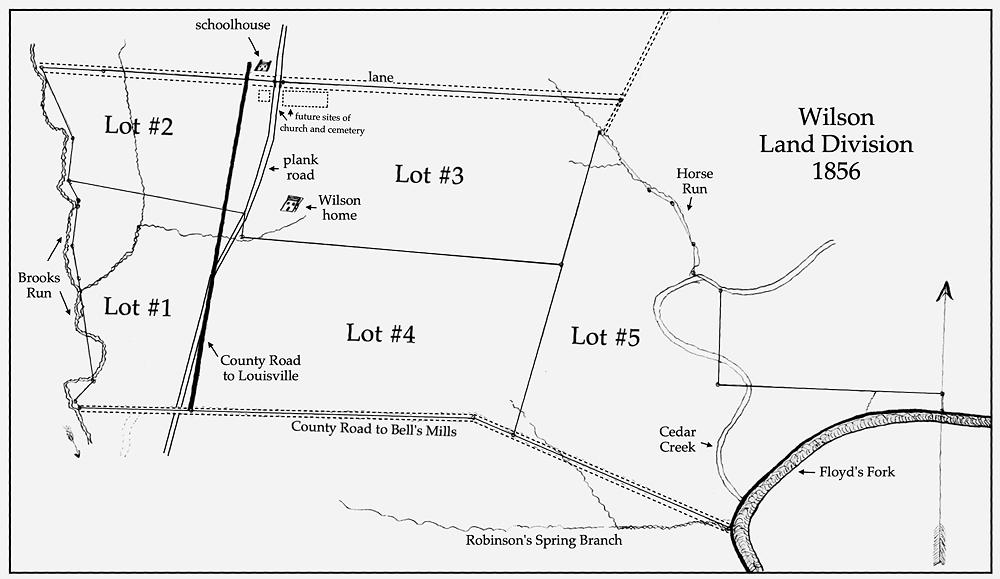
Thus in 1850 the Shepherdsville to Louisville Road was still largely a dirt road, at least in Bullitt County. It mostly followed the path of old two-lane Preston Highway, like the part that passes between Hebron Presbyterian Church and the Hebron Cemetery today. As shown here, we know from an 1856 deed dividing Matthew Wilson's land amongst his children that the stretch of this road between what are now Hebron Lane and Bell's Mill Road was then referred to as the Plank Road, indicating that progress was being made.
And more change was on the way.
In 1852, the population of Shepherdsville was estimated at 400, which was likely a bit high. The road to Louisville was mostly used by locals traveling to the City. About once a month folks from around the county would gather for Court Day; and the local Paroquet Springs Spa attracted small crowds from the City and neighboring counties. Beyond that, Shepherdsville was a quiet small town and would likely have stayed that way, except for one thing. There was excitement in the air about a train coming to town.
In March 1850, the Legislature granted a charter to the Louisville and Nashville Railroad Company to build and operate a railroad from Louisville to the Tennessee line in the direction of Nashville.
Several surveys were done, and the railroad decided that either of two routes would be acceptable. One would pass through Elizabethtown and Bowling Green; the other through Bardstown and Glasgow. The decision would be made based on which communities along the way were most willing to raise funds to purchase stock options in the company.
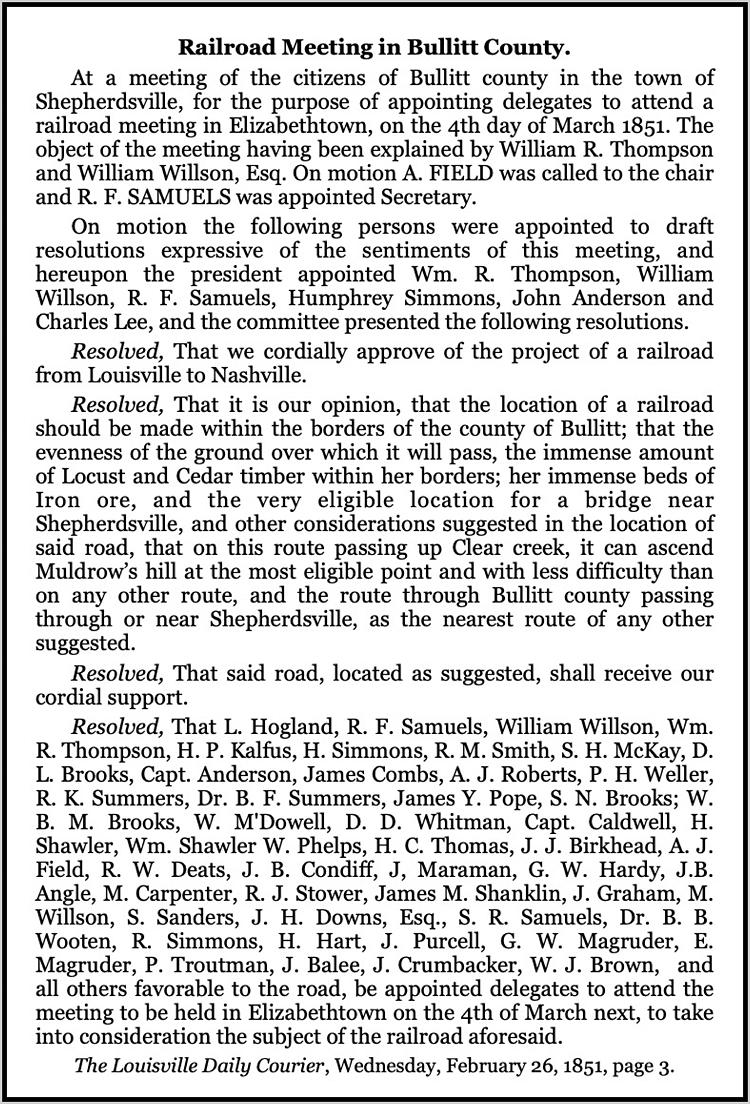
In February 1851, The Louisville Daily Courier reported on a meeting held in Shepherdsville strongly supporting the route that would cross Salt River at Shepherdsville on its way to Elizabethtown. We've transcribed this article and placed it here for you to read.
As excitement rose, a second meeting was held in October, again encouraging the railroad to come this way. It was reported that over $30,000 in stock had been subscribed in support of this action. $30,000 in 1851 is equivalent in purchasing power to over $1,300,000 in 2026.
The railroad was impressed by such efforts here, in Elizabethtown and other points along that route; and selected this to be the way to go.
Track was soon being laid, and by May 1853 the railroad was petitioning County Court to alter the road from Louisville as it passed through Gap in the Knob to permit the train tracks to share this opening between the knobs.
Then on October 8, 1855 Shepherdsville witnessed its first locomotive. One of its passengers, a reporter for The Louisville Daily Courier, had these comments.
"We were forty minutes running the eighteen miles to Shepherdsville, landing not exactly in the town, but in a grove of black jacks, with persimmon trees, covered with their fine fruit, scattered promiscuously about. Shepherdsville, from the rear, does not present the most fascinating appearance; yet we find it wearing its briskest, busiest air. It was the first day of the Circuit Court, and Judge Bullock was a passenger on the train, accompanied by Col. Thomas W. Riley, Capt. Rousseau, and other legal gentlemen."
Thus this judge and group of lawyers managed to come to town, handle their legal business, and return home that evening; rather that coming out the day before, spending the night in town, doing their legal work, spending another night in town, and returning to the City on the third day. Times were changing.
The reporter also wrote, "We found [the road] built in the most substantial manner and progressing as rapidly as the weather will allow. Salt River is already reached, and the erection of the bridge across that stream will be immediately commenced. It will take only three weeks to complete this structure, as the timbers are all in readiness, each marked for its place, the bolts and irons prepared, and nothing necessary but their being placed together."
The flooding of Salt River in 1854, resulting in a cholera epidemic that swept the town, also served as a warning to the bridge builders that their bridge needed to be high enough to avoid such a flood. To accomplish this they raised the bed of the railroad tracks, resulting in the creation of an underpass still used along the present Joe B. Hall Avenue as it passes beneath the tracks.
The road between Shepherdsville and Louisville would continue to be narrow and winding for years to come, but with the coming of the railroad, Shepherdsville would no longer be so isolated.
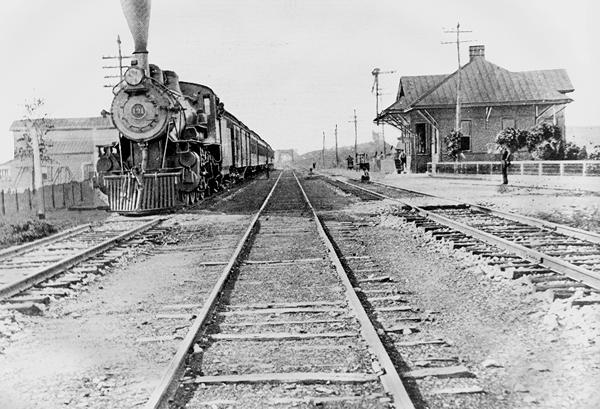
Today, with the four-lane Preston Highway and I-65, the railroad has become an afterthought, mentioned only when it disrupts our travel, but, as you can see in the picture shown here of the depot and tracks in 1905, for a long while it was really the way to go.
Copyright 2026 by Charles Hartley, Shepherdsville KY. All rights are reserved. No part of the content of this page may be included in any format in any place without the written permission of the copyright holder.
The Bullitt County History Museum, a service of the Bullitt County Genealogical Society, is located in the county courthouse at 300 South Buckman Street (Highway 61) in Shepherdsville, Kentucky. The museum, along with its research room, is open 10 a.m. to 4 p.m. Monday through Friday. Saturday appointments are available by calling 502-921-0161 during our regular weekday hours. Admission is free. The museum, as part of the Bullitt County Genealogical Society, is a 501(c)3 tax exempt organization and is classified as a 509(a)2 public charity. Contributions and bequests are deductible under section 2055, 2106, or 2522 of the Internal Revenue Code. Page last modified: 15 Sep 2026 . Page URL: bullittcountyhistory.org/memories/makingaway.html
