
The following article by Charles Hartley originally appeared in The Pioneer News in March 2026.
I recently reread A Nation of Immigrants first written in 1958 by then Massachusetts Senator John F. Kennedy at the behest of the Anti-Defamation League. Kennedy's great-grandfather Joseph Patrick Kennedy immigrated to the United States in 1847 from Ireland in the midst of the potato blight that caused severe famine in Ireland.
Among the many compliments received by this book was one by Secretary of State Marco Rubio, himself the son of Cuban immigrants to the United States. He wrote the following about this book.
"A Nation of Immigrants is an enduring reminder of where we—the United States of America—come from. We must remain mindful that there is much more that unites us than divides us-the shared values of family, the dignity of work, the hope for upward mobility, and freedom from oppression and persecution. John F. Kennedy's legacies are many but let A Nation of Immigrants always remind us of our shared dreams, goals, and destiny as a nation."
Kennedy's Irish heritage made him very aware of the injustices often experienced by those seeking a new life in our nation. Among the many things he had to say, this statement is especially worth sharing.
He wrote, "Immigration policy should be generous; it should be fair; it should be flexible. With such a policy we can turn to the world, and to our own past, with clean hands and a clear conscience. Such a policy would be but a reaffirmation of old principles. It would be an expression of our agreement with George Washington that 'The bosom of America is open to receive not only the opulent and respectable stranger, but the oppressed and persecuted of all nations and religions; whom we shall welcome to a participation of all our rights and privileges, if by decency and propriety of conduct they appear to merit the enjoyment.'"
And that brings me to Isaac, a German lad of 18 years who arrived in New York City in 1867, speaking almost no English, and leaving behind almost everyone he knew.
At the age of 13, he had been apprenticed to a commercial house for three years. The first year was spent sweeping, dusting, and delivering packages. In his second year he was taught how to sell goods, and in the third year he learned the science of bookkeeping, correspondence, and handling money. As an apprentice his only pay was room and board. He later remembered that these experiences taught him to love work, practice economy, and be self-reliant.
In the summer of 1866, an uncle from America, while on a business trip to Germany, described opportunities available in the United States, and offered to pay his passage and give Isaac a job if he chose to come.
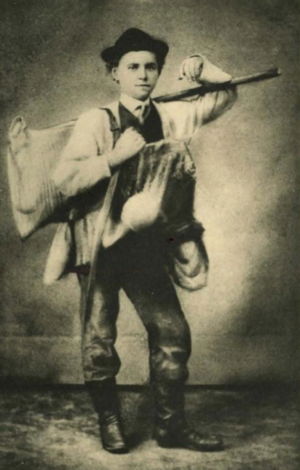
However when Isaac arrived in New York in March 1867 he found that the uncle's business had suffered losses and there would be no job.
Just when things seemed hopeless, a friend of his uncle who owned a store in Pennsylvania suggested that Isaac should try his hand at peddling "Yankee notions" in his part of Pennsylvania. His uncle bought the goods for Isaac on credit, guaranteeing the bill himself, and in May 1867 Isaac left New York to start his career as a peddler.
"Yankee notions" consisted of needles, pins, spool thread, socks, suspenders, handkerchiefs, and ladies' stockings; small things of little weight so that he could carry a large supply as he traveled from place to place.
This occupation afforded him the opportunity to familiarize himself with the language and customs of the people. He later recalled that it gave him a spirit of independence and self-reliance that stood him in good stead ever afterward.
On a personal note, I can relate to Isaac's experiences as I had an ancestor, also German, who came to America in the 1840's and earned his keep as a peddler.
Later, another uncle, who had his business in Paducah, Kentucky, offered Isaac a clerking job, and then his work ethic caused a wholesale liquor business to hire him as bookkeeper. When a job of salesman for the firm opened up, Isaac sent to Germany for his brother Bernard to be the bookkeeper and Isaac became the company's traveling salesman.
Lest you think that things just fell in Isaac's lap, the work ethic he had developed as a lad back in Germany, and his willingness to work hard were mostly responsible for his successes.
Both Isaac and Bernard wanted to begin a business of their own, and once again opportunity arrived when a local businessman, knowing their character, offered to be a silent partner in this new endeavor. As their business grew and prospered, they moved from Paducah to Louisville in 1888, then one of the great distributing centers for fine whiskeys.
As their business expanded and prospered even more, Isaac and Bernard wished to give back to the community. Among their contributions is a statue of Thomas Jefferson erected in 1901 which can be seen outside Louisville Metro Hall today. Another was a statue of Abraham Lincoln standing outside the Louisville Public Library facing Fourth Street.
Other donations included a wing on the Carnegie Free Public Library in Paducah, the first library of the Hebrew Union College in Cincinnati, and a complete water system for Isaac's birthplace, Schmieheim, Germany.
By now you may have guessed that I am talking about Isaac Wolfe Bernheim.
It was in 1929 that Isaac Bernheim created the trust that would perpetually fund a significant portion of the upkeep of Bernheim Forest. The once-overworked farm and timberlands were slowly transformed over the next twenty years, and the forest was opened to the public in July 1950.
Isaac Wolfe Bernheim died in 1945, and did not live to see his forest open to the public. However, his and his wife's graves were moved from Cave Hill Cemetery to Bernheim Forest in 1956. They rest on a hillside overlooking the Great Meadow with a beautiful sculpture standing watch over them.
Like many other immigrants down through the years, Isaac was grateful for the opportunities he found in his adopted home, and worked to make that home a better place for himself and others as well. I could have included any one of several pictures of Isaac Bernheim with this article, but I think we should remember him as the young peddler about to make his way in a new land.
We should never forget that, as George Washington said, "America is open to receive not only the opulent and respectable stranger, but the oppressed and persecuted of all nations and religions," for as Kennedy titled his book, we are truly A Nation of Immigrants.
Copyright 2026 by Charles Hartley, Shepherdsville KY. All rights are reserved. No part of the content of this page may be included in any format in any place without the written permission of the copyright holder.
The Bullitt County History Museum, a service of the Bullitt County Genealogical Society, is located in the county courthouse at 300 South Buckman Street (Highway 61) in Shepherdsville, Kentucky. The museum, along with its research room, is open 10 a.m. to 4 p.m. Monday through Friday. Saturday appointments are available by calling 502-921-0161 during our regular weekday hours. Admission is free. The museum, as part of the Bullitt County Genealogical Society, is a 501(c)3 tax exempt organization and is classified as a 509(a)2 public charity. Contributions and bequests are deductible under section 2055, 2106, or 2522 of the Internal Revenue Code. Page last modified: 01 Apr 2026 . Page URL: bullittcountyhistory.org/memories/immigrant-isaac.html
