
This is one of the recollections written by Wallace A. McKay and published in The Pioneer-News. Follow the "Recollections" link above to find others of his writings.
The Pioneer-News, February 17, 1933, pages 1-2
A Pen Picture And Sketch Of A Great Circuit Judge:
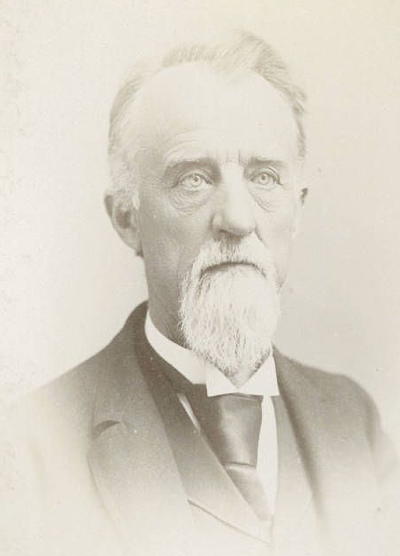
The Hon, Samuel E. DeHaven
The first Circuit Court Judge the writer ever knew, and by all odds the greatest, was Judge Samuel E. DeHaven of LaGrange, Oldham County, Kentucky. He was the last Judge of this District who served under the old Constitution. At that time Bullitt County was in a District with Oldham, Shelby, Spencer, Henry, and Trimble Counties and Circuit Court was held only twice each year. During those days Circuit Court day was a sure enough Big Day and the attendance was much larger, especially during the first week of the Court, than it is now. The three hotels in Shepherdsville, the Old American, Thompson's and Judge Hoagland's were full to an overflow and in addition a number of private citizens had quite a number of guests during the first week of Court. The Court House was a two story brick building in the center of the public square, and was always crowded beyond its capacity during Court week, In the spring and summer during the trial of some prominent criminal case, the doors and windows were left open so as to permit the overflow crowd in the Court Yard to hear the proceedings.
Judge DeHaven was a distinguished looking man, just in the prime of middle-age. He was tall with iron gray hair and beard and mustache and dressed with neatness and care, usually in frock tails and a stove pipe hat. On the bench he was somewhat austere and dignified and required the sheriff to keep perfect order while Court was in session. A breech of this rule always brought quick punishment. Off the bench, however, he was quite approachable and pleasant. Judge DeHaven was above average height and weighed around 170. At that time he was a bachelor and usually he stopped at the Hotel of Judge Lorenzo Hoagland, then located just south of the present residence of Mr. C. F. Troutman. Frank P. Straus had boarded at the Hoagland House for years and visiting lawyers usually stopped there in order to keep in contact with the Judge.
Although quite a small boy, the writer remembers the semi-annual visits of Judge DeHaven and the great respect and awe in which he was held by the public in general. The Judge had been an active and successful practitioner at the Bar, a Member of the House of Representatives and the State Senate before his election as Circuit Judge. He had always been a close student of the law and when be entered upon his Judicial career he was one of the very best equipped men in the State. He had all the rules of evidence at his finger tips, remembered and accurately quoted the decisions of the Appellate Court on important questions, before the attorney in a case would have time to read it from the Reports; was patient, fair and courteous in his treatment of all the members of the Bar, and it was conceded by everyone that he had no favorites or pets among the lawyers, but treated one and all alike, regardless of his talents, influence or prestige. He was particularly kind and patient to young lawyers, just beginning the practice, and was uniformly helpful to them.
Judge DeHaven came from a fine old pioneer family and was born at Worthington in the East end of Jefferson County, in 1826, and after teaching school for several years, located at LaGrange and began the practice of law there in 1850, ten years before the beginning of the Civil War. He was elected Circuit Judge in 1875 and served until 1891. During his last term as Judge, he was elected to be a delegate to the Convention which prepared and adopted the present Constitution of Kentucky. In the beginning of his career as a lawyer he was industrious and saving and made a practice of investing his savings in land lien notes at a discount. He also bought desirable tracts of and whenever he could buy at a real bargain and as a result he accumulated a large estate and left considerably over a quarter of a million in lands and personalty. He married late in life, when about 51, and never had any children. In his will, after providing for his wife bountifully during her life, divided his estate between about 100 nephews and nieces and other collateral kindred. It took about ten years to settle this estate and cost about $30,000.00 in Court costs, Executors' fees, commissioners' fees and attorney's fees He left $5000 00 in trust for the Common Schools of LaGrange and after his death his widow constructed a beautiful stone church in LaGrange and donated it to the Baptist denomination It is called "The DeHaven Memorial Church."
Judge DeHaven was by and large the ideal Circuit Judge. In after years the writer studied law and has practiced in the Courts of many Circuit Judges, but never came in contact with the equal of Judge DeHaven. Hon. Frank P. Straus and Senator Charles Carroll, who ought to have been competent Judges, often declared that Judge DeHaven was the ablest, the fairest and most skillful Trial Judge they ever practiced before during their long experience in the Circuit Courts of this Commonwealth.
W. A. M.
If you, the reader, have an interest in any particular part of our county history, and wish to contribute to this effort, use the form on our Contact Us page to send us your comments about this, or any Bullitt County History page. We welcome your comments and suggestions. If you feel that we have misspoken at any point, please feel free to point this out to us.
The Bullitt County History Museum, a service of the Bullitt County Genealogical Society, is located in the county courthouse at 300 South Buckman Street (Highway 61) in Shepherdsville, Kentucky. The museum, along with its research room, is open 10 a.m. to 4 p.m. Monday through Friday. Saturday appointments are available by calling 502-921-0161 during our regular weekday hours. Admission is free. The museum, as part of the Bullitt County Genealogical Society, is a 501(c)3 tax exempt organization and is classified as a 509(a)2 public charity. Contributions and bequests are deductible under section 2055, 2106, or 2522 of the Internal Revenue Code. Page last modified: 15 Jun 2026 . Page URL: bullittcountyhistory.org/bchistory/wallace-pn-9.html
