
This is one of the recollections written by Wallace A. McKay and published in The Pioneer-News. Follow the "Recollections" link above to find others of his writings.
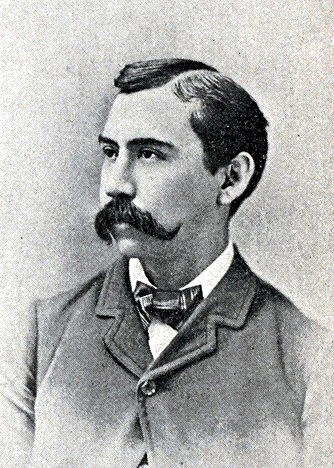
The Pioneer-News, December 16, 1932, pages 1-2
After Congressman J. Proctor Knott was nominated for Governor in 1883, the younger and ambitious Democrats of the 4th. district at once began to look over the field with a view of becoming candidate to succeed Mr. Knott.
For years these men had realized that as long as Congressman Knott continued in the field it was no use for any other candidate to consider making the race. He was so securely established in the Public's mind as a great National character that ne one else in the district would have had a chance to defeat him and for years he had no opposition for re-nomination in the Democratic party and even less opposition in the Republican party.
His nomination for Governor gave the other boys their chance and they were not slow in taking advantage of it.
A number of candidates announced to succeed him, among others Dr. S. M. Hobbs of Mt. Washington, Judge E. Dudley Walker of Ohio County, Hon. W. O. Cunningham of Springfield and Tom Robertson of LaRue County. Dr. Hobbs was one of the finest men Bullitt County ever produced. He had a large practice in Bullitt, Spencer and Nelson Counties and was universally esteemed for generous, kindly disposition, skill as a physician and enterprise and public spirit as a citizen.
The Democratic Committee of the district decided on a convention to settle the nomination and the convention of Elizabethtown was a notable one in the political annals of the district. The four votes of Bullitt County were cast for Dr. Hobbs and he received on different ballots a number of other complimentary votes from the other Counties of the district. After a dead-locked convention of several days, Tom Robertson of LaRue County was nominated. He was a tall, red haired man with a most lovable and attractive personality. He was full of good humor and wit and had a great faculty for telling stories. He was universally popular and was re-elected for two or three terms in the face of strong opposition. His convivial disposition proved his down-fall and by reason of his unfortunate habit contracted in Washington, he was finally defeated by Judge A. B. Montgomery of Elizabethtown, one of the most astute politicians the district ever produced.
After his first election, Montgomery was never defeated in the party for nomination, but was finally defeated about the year of 1894 by the Republican nominee, Hon. John W. Lewis of Washington County. This ended Montgomery's political career, the Judge retiring to his home and law practice at Elizabethtown, where he lived to a ripe old age.
The hardest fight Montgomery had for a nomination was during his candidacy for a third term when he was opposed by a very brilliant young attorney from Washington County, Walter Scott Clements. Clements was then about thirty years old and had a successful career as a lawyer at Springfield. He was a fine speaker, a great student and a man of far more than average ability. He made a brilliant campaign and a fine impression throughout the district. He was by common consent the most talented and promising Democrat in the district since the days of Procter Knott. The race between Montgomery and Clements was close and exciting and resulted in a victory upon the face of the returns for Montgomery by a close margin.
The political machinery of Hardin and adjoining counties was in the control of Judge Montgomery and the vote returned from Hardin county was abnormally large, and this vote gave the nomination to Montgomery. Clements and his friends always claimed he was nominated, if the election had been fairly conducted, but were barred from contesting by reason of the fact that the committee which would have heard the contest was in the hands of Montgomery's friends. Clements took his defeat very much at heart and instead of remaining in the district and making the race two years afterwards, which he could have won, he moved from the district and located in Louisville where he has since practiced law.
If Clements had remained in the district a few years and kept himself before the public there is hardly a question but that he would have been elected to Congress and with his natural talent and ability as an orator would have no doubt made a distinguished record in Congress. There are many hundreds of his friends and admirers throughout the district. who to this day, express their very deep regret over his removal from the district, which they believe, was the only barrier to a successful and distinguished political career.
Tom Robertson died in the prime of his life, a few years after his defeat for re-election to Congress and Mr. John Walter Scott Clements is still living and enjoying life among his new made friends in the city of Louisville. Since bis residence in the city he has taken part in a number of big law cases in which he displayed real ability as a successful trial lawyer.
W. A. M.
If you, the reader, have an interest in any particular part of our county history, and wish to contribute to this effort, use the form on our Contact Us page to send us your comments about this, or any Bullitt County History page. We welcome your comments and suggestions. If you feel that we have misspoken at any point, please feel free to point this out to us.
The Bullitt County History Museum, a service of the Bullitt County Genealogical Society, is located in the county courthouse at 300 South Buckman Street (Highway 61) in Shepherdsville, Kentucky. The museum, along with its research room, is open 10 a.m. to 4 p.m. Monday through Friday. Saturday appointments are available by calling 502-921-0161 during our regular weekday hours. Admission is free. The museum, as part of the Bullitt County Genealogical Society, is a 501(c)3 tax exempt organization and is classified as a 509(a)2 public charity. Contributions and bequests are deductible under section 2055, 2106, or 2522 of the Internal Revenue Code. Page last modified: 15 Jun 2026 . Page URL: bullittcountyhistory.org/bchistory/wallace-pn-2.html
