
This is one of the recollections written by Wallace A. McKay and published in The Pioneer-News. Follow the "Recollections" link above to find others of his writings.
The Pioneer-News, March 10, 1933, pages 1-2
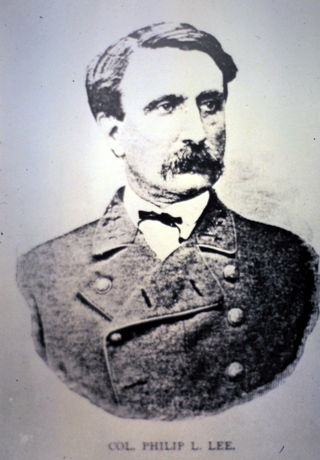
Colonel Phil Lee: A Great Kentucky Hero
Phil Lee, third son of Wilford and Margaret Lee, was born in Bullitt County, Kentucky, October 22, 1832. His father, who emigrated from Virginia in early life, was intimately related to the old revolutionary families of that name, and possessed, in no ordinary degree their high sense of manly freedom, and that decision of character which forbids a man to halt between duty and interest, principle and policy.
The subject of our sketch was educated at St. Joseph's College, Bardstown, graduating at that Institution at eighteen years of age. He shortly afterward entered the University of Louisville, and in 1852, at the age of twenty, he graduated in the law class there, and was admitted to the bar. In the practice of his profession he has always been considered by his friends as an able advocate, particularly before juries.
In 1853, not having attained to his majority, he was elected to represent Bullitt County in the legislature, and was, it is said, the youngest member who ever sat in that body. Here he served two terms, having been elected in 1885. In 1856, he was candidate for Presidential elector on the Fillmore ticket in opposition to Gov. Magoffin, and in 1860 was on the electoral ticket for Bell and Everett, opposed by Judge Marcus R. Hardin and Captain Graves. This canvass is described as a most spirited one. The country was aroused, danger to our institutions seemed imminent, and the speakers were excited to more than common exertion. For three months they addressed the people almost daily; and, in this contest, the strong points of Colonel Lee, as a popular debater, so fully developed themselves that before the close of the campaign he had won a reputation for ready polemic wit a certain sharp invective, end, when it better suited his turn, broad old Kentucky humor, all of which combined to make him on antagonist to be feared on the stump since these characteristics enabled him to suit his address to the occasion and to reach every class of people whose sympathies, it appears, were always enlisted in his favor, if not in that of the men whom he represented.
Early in 1861, true to his blood and lineage, he came out boldly for the South, declaring that the honor of Kentucky was at stake, that an alliance with the South was the only natural and legitimate course that Kentucky could pursue. He pronounced the neutrality policy "a foolish and impracticable thing," a trick of demagogues to deceive the too confiding people; and he advised them to take no counsel of their fears, nor to consider for a moment the promptings of that base spirit of "policy" that led men to stand aloof from the struggle, or to ally themselves with the strong against the weak, for the more ignoble purpose of preserving their property.
He continued his connection to the purposes and measures of the Government until further efforts were vain, the chances for giving the Confederacy substantial aid were growing more and more dangerous and uncertain when he set about enlisting men for the Southern service, and soon repaired with more than one hundred men, emphatically young men, for there was but one married man among them, to a point in Tennessee near the Kentucky line, where, in company with Moss Breckinridge and Tilgham, July 4, 1861, he assisted in laying ut the historic "Camp Boone."
July 16, 1861 his Company was organized under the designation of "C" Second Kentucky, of which he was afterward the Colonel.
"Continued Next Week"
W. A. M.
The Pioneer-News, March 17, 1933, pages 1-2
Continued from last week
Shortly after this, he, "Captain Lee" was ordered by Col. Bob Johnson, then commanding, to take charge of 100 picked men and penetrate, as far as practicable, into Kentucky, for the purpose of disarming home guards and securing guns for the Confederate troops.
Accordingly, August 20, 1861 he set out with his detachment "among whom was the gallant and soldierly Graves" and capturing a train of cars, he proceeded almost as far as Bowling Green. This instant is noteworthy chiefly on account of it having been the first Confederate raid into Kentucky and the capture of the first train.
Henceforth, until the disastrous close of the great struggle, his history is interwoven with that of the immortal second regiment whose exploits at Ft. Donelson, in which it alone of the First Brigade took part, sent a thrill of joy to the hearts of Kentucky soldiers everywhere.
At Ft. Donelson, then Captain Lee first led his company into action and proved himself worthy of the name he bore and of the confidence of his men. Imprisoned for six weary months, his regiment at length came forth to win her laurels at the battle of Heartsville Tennessee.
Captain Lee was present at every engagement in which his regiment participated during the war except that of July 22nd., near Atlanta, and demeaned himself alike in all. Always active and vigilant, he inspired confidence and won honors in the path of danger and of duty. At Chickamauga, although ill, he was acting field officer, and is referred to in the report of the Commanding Officer as having done his duty "with his accustomed gallantry." Shortly after this battle, he was promoted to Major and on Nov 5, 1861, to Lt. Colonel. On the campaign from Dalton to Atlanta he received the only wounds that were inflicted upon him during the war. He was painfully wounded at Resaca, May 14, 1862 and received at Dallas, Georgia a slight wound. On the fall of Colonel Moss at Jonesboro, Georgia, August 31, 1861, he was promoted to Colonel of his regiment and commanded the second regiment to the close of war.
A writer in the Louisville Courier, some years ago, gave us a description of Colonel Lee in the following terms, which though very general, are yet accurate and give a fair idea of his appearance. "Stature, medium, with a heavy, muscular frame, a piercing gray eye, and a countenance beaming with genial good humor."
In the army, as well as at home, the suavity and cheerfulness of his general deportment made him friends, and the esteem in which he was held in his own regiment attested the goodness of his heart. To him it was a source of great pride that he always had a love of the brave boys who were under his orders; that he was always welcome with a smile and pleasing courtesy whether at the marquee of the general or the camp-fire of the soldier. General Hanson once remarked "that Phil Lee's flow of spirits, his pleasantry, and genial wit got far toward lightening the toils of a campaign, since they always keep the regiment in good humor."
In the closing days of the war when the cause of the South was irretrievably lost, Col. John W. Caldwell and Col. Lee made speeches to the remainder of their regiment which had survived the perils of battle.
Col. Lee concluding his farewell speech to his soldiers, conceived that matters were growing too serious, so he brought his humor into play and dispersed the command with a laugh. "Boys," said he, with his drollest serio comic air, "the General speaks of not wearing the Yankee uniform. Now, as for Phil Lee, my opinion is that henceforth he will wear no uniform of any sort."
The Pioneer-News, March 24, 1933, pages 1-2
Concluding Article In Regard To Bullitt County's Great Hero Of The Civil War
Col. Phil Lee - A Monument In His Honor Proposed
In the two former articles the writer, in considerable detail, gave a history of the military record of Col. Phil Lee as an officer in the 2nd Kentucky Infantry of the Confederate Army. This matter was secured after much research into the records of the Confederate Soldiers of Kentucky during the Civil War, and can be relied upon to be substantially accurate.
The writer, of course, never knew Col. Lee or saw him during his life, as he died before my time. The writer's father and mother and grandfather and grandmother, however, knew Phil Lee intimately, and in his childhood he heard the character and achievements of the gallant soldier talked of in his home and around the family fireside on divers occasions. He also heard him spoken of frequently by the late James Y. Pope, the father of Ben, James W. and Bert Pope. Mr. Pope knew Phil Lee intimately from his childhood and knew his father and uncle, Charles Lee. From my earliest childhood, the writer was taught to love, admire, and respect the memory of this Bullitt County hero, whose courage and gallantry in battle and dash and brilliancy as a lawyer, greatly endeared him to a host of Kentuckians in that romantic period of our history following the Civil War.
At the close of the war, Col. Lee resumed the practice of his profession at Bardstown. He returned to Louisville in 1866 and at once took a prominent place at the bar of that city. In 1868 he became a candidate of the Democracy of the 9th Judicial District for Commonwealth's Attorney. and after a heated contest, was elected; was re-elected without opposition in 1874, and distinguished himself as one of the most gifted and able men who had filled that position in his district.
He died while at the zenith of a career of great promise, in the year 1875. His untimely death was a great shock to the people of Kentucky, and caused universal mourning. His funeral, in the city of Louisville, was one of the greatest gatherings of distinguished Kentuckians since the close of the Civil War, and the entire press of the State extolled his virtues in the most laudatory editorials.
Col. Lee was married June 23, 1866 to Miss Bell B. Bridgeford, the talented and beautiful daughter of the Hon. James Bridgeford, an able business man and one of the most distinguished citizens of Louisville.
Col. Lee's eldest son, William Bridgeford Lee, graduated in the same class with the writer at the Law Department of the University of Louisville, and is yet living.
The memory of such a man as Phil Lee will ever be enshrined in the hearts of the lovers of the South, and the Southern cause. His fame as a man, a soldier, and as Commonwealth's Attorney is written in letters of gold on the Walls of Time and will grow brighter as time goes on. Few men of his time were more beloved. anecdotes and stories of his life and career are among the most precious traditions of Bullitt County. It would be only fair to state that in all its History from the pioneer days down to the present, Bullitt County never produced a greater hero, and in order that the chivalry and courage and noble character of such a man may be perpetuated and transmitted to the coming generations for our young men to emulate, the writer would like to see an Equestrian Statue of Phil Lee, erected in the Court House yard at Shepherdsville. The Daughters of the Confederacy, no doubt, would unite with the people of Bullitt County in such an enterprise.
The writer would like to have the opinion of the Editor of Pioneer-News as to this suggestion as well as some of you correspondents. Both the writer's father, Capt. Charles W. McKay and Col. Phil Lee participated actively in the great battle of Chickamauga, the former an officer in the Union Army, the latter an officer in the Confederate Army, and after the war they often discussed the interesting features of this great battle of the Civil War which lasted without ceasing three days and three nights.
If you, the reader, have an interest in any particular part of our county history, and wish to contribute to this effort, use the form on our Contact Us page to send us your comments about this, or any Bullitt County History page. We welcome your comments and suggestions. If you feel that we have misspoken at any point, please feel free to point this out to us.
The Bullitt County History Museum, a service of the Bullitt County Genealogical Society, is located in the county courthouse at 300 South Buckman Street (Highway 61) in Shepherdsville, Kentucky. The museum, along with its research room, is open 10 a.m. to 4 p.m. Monday through Friday. Saturday appointments are available by calling 502-921-0161 during our regular weekday hours. Admission is free. The museum, as part of the Bullitt County Genealogical Society, is a 501(c)3 tax exempt organization and is classified as a 509(a)2 public charity. Contributions and bequests are deductible under section 2055, 2106, or 2522 of the Internal Revenue Code. Page last modified: 15 Jun 2026 . Page URL: bullittcountyhistory.org/bchistory/wallace-pn-12.html
